
 reviews -





Choosing the right pressure washer starts with your cleaning jobs, not the biggest number on the box. Matching a duty level to your surfaces and reading pressure and flow figures properly come first. Machine types, Kärcher and Nilfisk ranges, accessories, water supply and running costs then narrow the choice.
How to Choose the Right Pressure Washer
- Match the duty level, pressure and flow to your cleaning jobs
- Choose hot water models for grease and oil removal
- Compare electric, cordless and petrol power
- Check nozzles, attachments, water supply and running costs

Match the pressure washer to the cleaning job
Begin with the hardest surface you need to clean safely, then think about the size of the area and how often you clean it. A machine built for bicycles will struggle on a driveway. Conversely, one chosen for stubborn paving dirt can be too harsh for timber or vehicle paint.

Choose a duty level for your jobs
Each duty level reflects a typical mix of surfaces, area and frequency. In UK categories, motor rating, pressure and hose length all rise together from one level to the next:
- Light-duty pressure washers: suited to bicycles, garden furniture, small cars and small areas of lightly soiled paving. Their lower flow can make larger jobs slow.
- Medium-duty pressure washers: for regular cleaning of cars, decking and garden paving, typically with a 1,600–2,000 W motor and 100–130 bar. Hoses usually run to 5–6 m.
- Heavy-duty pressure washers: domestic or semi-professional machines for extensive paving and grimy large vehicles. They typically draw 1,800–2,500 W and deliver 130–150 bar.
Once you have a duty level in mind, check its figures against a recommended minimum for each job. A UK buying-guide table sets these minimum combinations of pressure, power and flow rate:
| Job | Pressure | Input power | Flow |
| Bikes or garden furniture | 110 bar | 1,400 W | 360 l/h |
| Cars | 120 bar | 1,600 W | 400 l/h |
| Patios, roofs or gutters | 140 bar | 2,000 W | 500 l/h |
| Exterior walls | 160 bar | 3,000 W | 600 l/h |
| Agricultural, industrial or construction equipment | 210 bar | 4,000 W | 600 l/h |
Treat these rows as buying benchmarks rather than safe settings for every surface. A patio rating tells you the machine can handle the job. It does not tell you how much force a particular paving stone can take.
Read pressure, flow and wattage together
Pressure, measured in bar, describes the force of the jet. Cleaning power also depends on the nozzle, working distance, soil and surface condition. One bar is about 14.504 psi. That puts 100 bar at roughly 1,450 psi and 130 bar at about 1,885 psi, but no psi range is universally safe for residential use.
Alongside pressure, flow in l/h is the volume of water that carries loosened dirt away, which matters on large areas. The detail that matters here: compare like with like, meaning maximum flow against rated flow and maximum pressure against working pressure. Wattage only shows the power drawn, so read power and flow rate together. Manufacturers' m²/h figures are screening estimates, not guaranteed cleaning rates.
Protect the surface you intend to clean
However strong the machine, start every surface on an inconspicuous patch with a wide fan spray, plenty of distance and the lowest setting that works. Vehicle paint, seals and sensors need particular care. On softwood decking, too much force can gouge the timber or lift its fibres.
Sound concrete and robust paving can withstand more force than fragile finishes. Even so, a concentrated jet can wash jointing material out of block paving. For old masonry, soft stone, render and damaged coatings, a brush-based or specialist method may suit better than pressure washing.
Choose a machine type and model range
When you know your duty level, the next step is choosing a power source and then a model range. Each of the types of pressure washers trades mobility against output and maintenance. The choice also changes between domestic and professional workloads.

Explore our range
Karcher Pressure Washers
Compare electric, cordless and petrol power
Electric pressure washers generally suit domestic work wherever a suitable socket is available, and you avoid petrol and engine-oil maintenance. A cordless pressure washer frees you from the cable. Check its battery runtime, charging time and output before taking on a large, heavily soiled job.
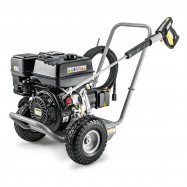
Conversely, petrol pressure washers can work well away from a socket and commonly deliver higher pressure and flow. In return, they are heavier and noisier and need fuel and engine maintenance. Petrol engines must never run in enclosed spaces.
For repeated workplace use, confirm the exact machine's continuous running time, rest periods, daily workload, maintenance and service support. A high bar rating or a metal pump does not prove a machine's duty cycle. The UK Health and Safety Executive requires electrical equipment to suit both the work and the supply, and to be maintained and risk-assessed.
Compare Kärcher and Nilfisk domestic ranges
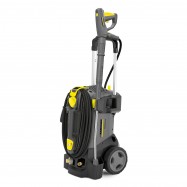
Kärcher positions its K 2 models for occasional light jobs. For regular domestic cleaning, a Kärcher power washer such as the K 4 Classic offers 130 bar maximum pressure and 420 l/h flow. It draws 1,800 W and comes with a 6 m high-pressure hose.
Larger domestic areas call for more flow and reach. A K 5 WCM specification lists 145 bar, 500 l/h maximum flow and 2,100 W input. It adds an 8 m hose and a stated area performance of 40 m²/h. Kärcher's K 7 class reference reaches up to 180 bar and 600 l/h, with 60 m²/h, though not every variant is guaranteed those figures.
Nilfisk covers the same jobs. The Classic 110 suits occasional cleaning, with a 5 m hose and up to 25 m²/h. Core 140 documentation separates 465 l/h maximum flow from 348 l/h under its QIEC test. The Excellent 170-10 has a 10 m hose and a manufacturer-stated index of 55 m²/h. Worth checking before you buy: the exact variant and accessory bundle.
Choose professional cold or hot water
For professional work, Hortech Cleaning lists Kärcher professional cold-water pressure washers, from portable HD units to specialist cage machines. The HD 4/10 X Classic has automatic pressure relief and an integrated reel. The HD 13/35-4 Cage reaches up to 350 bar for stubborn dirt. Hortech Cleaning also stocks Nilfisk cold-water pressure washers, ranging from compact MC 2C and MC 3C mains models to high-flow MC 8P machines.
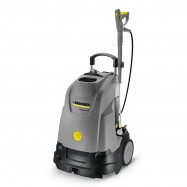
Where the job involves heavy grease and oil, hot water can make a real difference. Hortech Cleaning lists Kärcher HDS hot-water pressure washers, from portable units to machines with detergent tanks, plus the diesel-powered HDS 1000 DE. These machines are sold subject to a site survey. Before purchase, confirm voltage and phase, fittings, wastewater controls, maintenance and repair arrangements.
Recommended products
Check features, water supply and total cost
Two machines with the same specification can still perform very differently on site. The difference often comes from the lance, the hose, the tap supply and the cost of running the machine over its life.
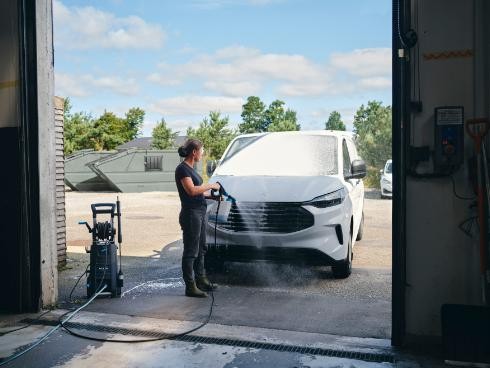
Select nozzles, attachments and reach
An adjustable lance or a set of interchangeable tips changes the spray pattern. A broad fan spray is the controllable starting point for delicate surfaces. A rotating jet concentrates the cleaning action on robust surfaces, but it is not suitable for car paint or decking. Beyond the nozzle, other accessories each serve a specific job:
- Patio-cleaning head: cleans flat paving more evenly, with less overspray and less risk to block-paving sand than an exposed nozzle.
- Foam applicator and soft brush: apply detergent and lift dirt from vehicles. They do not make excessive pressure safe.
- Angled lance: reaches beneath cars and furniture.
Hose length decides how often you move the machine. UK guidance calls a 3 m hose too short for a car and 5 m adequate. A longer approved pressure hose, a hose reel and onboard storage all improve handling. Extension hoses can reduce water pressure, so confirm connector, pressure and flow compatibility.
Verify the water supply and restrictions
Your tap, supply hose and fittings must meet the washer's specified inlet flow and pressure. For a quick bucket test, divide the litres filled by the seconds taken, then multiply by 3,600. Filling 10 litres in 60 seconds indicates 600 l/h at that outlet. That figure is not a guaranteed flow through the washer.
Where practical, run that test with the hose and fittings you intend to use. Before starting, keep the hose free of kinks, open the tap fully, clean the inlet filter and purge air as the manual directs. Drawing from a water butt or tank needs model-specific suction capability. Under a UK Temporary Use Ban, a pressure washer has no general exemption. Ofwat says breaching an applicable ban can lead to a fine of up to £1,000. On commercial sites, oily runoff may need collecting rather than draining.
Compare purchase and running costs
Compare complete set-ups: a bare unit against a kit with a patio head, vehicle tools or a detergent system is not a fair match. Hortech Cleaning stocks spares and accessories and offers free demonstrations of industrial cleaning equipment. Electricity use equals input in kW multiplied by hours. A constant 1.8 kW for 30 minutes uses 0.9 kWh, before trigger-off periods. To estimate water, multiply the stated l/h by trigger-on hours, and compare totals per completed job.
On top of those figures, allow for detergent, water and wastewater charges, replacement parts and servicing. Professional buyers should also weigh downtime, installation and wastewater management. Hortech Cleaning provides workshop and on-site servicing. Maintenance intervals and frost-free storage requirements depend on the exact model.
Expert help choosing your pressure washer
From Kärcher and Nilfisk domestic models to professional cold and hot water machines, our family-run team has over 20 years of hands-on experience. Find out how we can help.
Frequently Asked Questions
It is not a suitable general method, because a pressure jet can strip out the jointing material along with the weeds. Inspect the joints and pointing first. Avoid aiming a concentrated jet into them, since it can dislodge sand or mortar.
Rubber hoses tend to be more flexible and more kink-resistant than PVC hoses. Lengths and materials vary, so compare both against your machine and your jobs.
Stop increasing intensity as soon as the surface begins to erode, fray, discolour or shed material. Start on a small hidden area with the lowest effective pressure, a broad spray and generous distance. Increase intensity only while the surface stays sound.


